Athlete performance testing: Choosing tests and tracking progress
Understand athlete performance testing, measurement error and repeat results. Learn what parents and coaches should ask when tracking youth development.

· 5 min read
Key points
- Choose tests that are valid, reliable and sensitive to useful change.
- Compare score changes with measurement error and test conditions.
- Interpret youth results alongside growth, maturity and personal history.
Athlete performance testing measures a defined physical quality with the same method. But, one score cannot explain progress on its own. A test must measure what it claims to measure. Repeat scores should be close. It should also detect real change.[1] So, read results with past tests, test conditions and the athlete’s stage of growth.
Why might a score fall from one month to the next? Fatigue, practice with the test and test error may all play a part.[3,4] First, ask what the test measures. Then consider what the difference means. This guide sets out that process for athletes, parents and coaches.
How should you choose athlete performance testing methods?
A useful test measures the intended quality and gives stable scores on repeat trials. It should also detect small but useful changes. Currell and Jeukendrup explain these three traits together.[1] Use this set of questions when choosing a test:
Validity: What does the test measure, and does that fit the sport and goal?
Reliability: How much does the same person’s result vary under similar conditions?
Sensitivity: Can the test distinguish the change you want to track from test noise?
First, write down the purpose. Then ask the person running the test to explain these three points. A test that is easy to use is not right for every purpose.
Which physical qualities can tests measure?
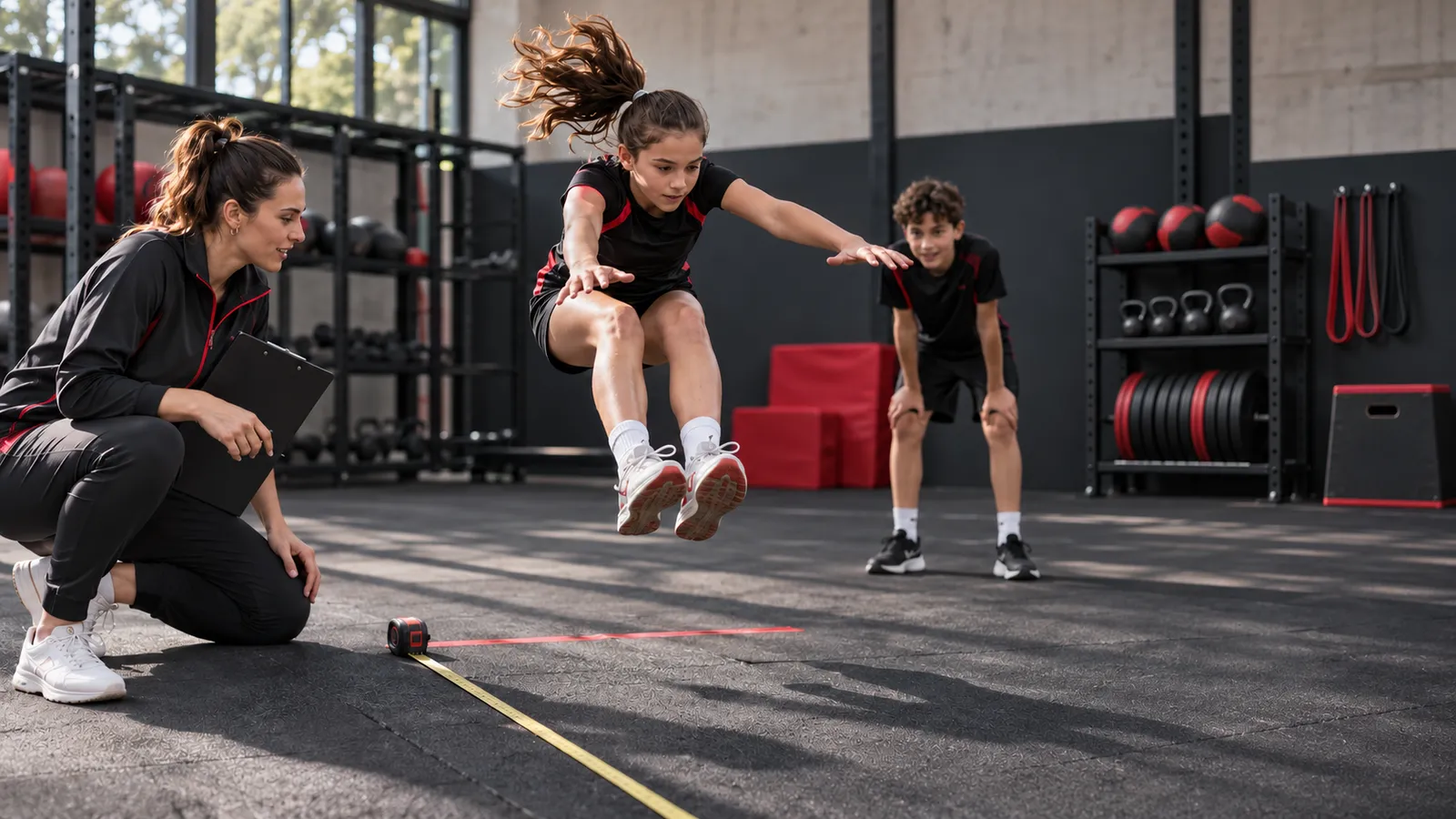
The choice depends on the sport and the question. Common areas include speed, strength, jumping, change of direction and endurance. But, these tests do not all provide the same detail.
Speed: Time taken to cover a set distance.
Power and jumping: Measures related to producing force quickly.
Strength: Force produced against resistance.
Change of direction: Speeding up, slowing down and moving in a new direction.
Endurance: How long you can keep up a task or pace.
Body composition: Measures related to fat and lean tissue.
These qualities overlap. For example, Suchomel and colleagues explain the role of strength in sprinting, jumping and changing direction.[2] They also review static, dynamic and reactive ways to assess strength. In an isometric test, the muscle makes force with little change in length.
Endurance also needs a fit-for-purpose test. Currell and Jeukendrup explain time trials that resemble competition.[1] Yet no single test represents every part of a team sport. Skills and match context still matter.
Why does test error matter?
Test error tells us how much trust to place in a change. Repeat results can differ even for the same person. Learning and fatigue can create shifts in one direction. The body and the test tools can also add random changes.[4]
Hopkins uses typical error to describe changes across repeat tests.[3] In some measures, error can be shown as a percentage of the mean. This is the coefficient of variation, or CV. Ask how large the error is for the test and group in question.
But, a high correlation alone is not enough. Atkinson and Nevill explain that correlation can change with the spread of scores in a group.[4] So ask about the size of the error, not just whether two tests correlate.
How can real progress be split from noise?
Compare the score change with both test error and the change that would matter in practice. A very small difference may be hard to read. But, doubt does not prove a lack of progress.[1,3,4]
Currell and Jeukendrup describe this as a signal-to-noise problem.[1] The signal is the change you want to track. The noise is variation in the measure. So, the same methods are key when tracking small gains.
This is especially right in elite sprinting. Haugen and colleagues explain small changes with outside factors.[5] Wind and timing methods can affect comparisons. Simply putting two times next to each other is not enough.
How should the first test and repeat tests be read?
A first test may include a learning effect. For example, an athlete may do better next time because the task feels familiar. Hopkins explaines learning, motivation and fatigue as influences on average results.[3]
First, learn the method. Then repeat it under similar conditions. This makes the personal trend easier to read. But, no single repeat interval fits everyone. Choose the timing around the purpose and training phase.
Why do youth results need special care?
Children of the same calendar age may differ in maturity. A ranking on one day so cannot define long-term potential. Malina and colleagues explain growth, maturation and selection in youth sport.[7]
For example, growth-related differences can affect scores. Also, methods that estimate maturity do not all offer the same certainty.[7] Do not present an estimate as an exact biological age.
Lloyd and Oliver also explain the limits of grouping children by calendar age alone.[8] Read the child’s results with past scores and growth. Do not use them as a diagnosis or a final verdict on talent.
How can clubs use the data?
Data should lead to a clear question and follow-up. Thornton and colleagues stress useful analysis and clear feedback.[6] So, record the decision the coach is trying to inform, rather than simply filing the report.
Agree on the test purpose, method and error detail.[1,3]
Review dates, conditions and the athlete’s past results.[3,4]
For children, discuss growth and maturity.[7,8]
Set the next question, person in charge and review.[6]
Parents can ask: is this change larger than the test’s usual error? If pain or a health concern is present, seek advice from the right health professional.
How does Athletic Labs support development tracking?
Testing, reports and coach explainions form one follow-up process. Explore our guide to tests across 25 sports. Also, use the parent’s guide to development reports to prepare your questions.
Finally, discuss your club’s testing needs with Athletic Labs. Athlete performance testing supports decisions. It does not provide a diagnosis or a guarantee against injury.
References
- Currell K, Jeukendrup AE (2008). Validity, reliability and sensitivity of measures of sporting performance. Sports Medicine, 38(4), 297-316. https://doi.org/10.2165/00007256-200838040-00003
- Suchomel TJ, Nimphius S, Stone MH (2016). The importance of muscular strength in athletic performance. Sports Medicine, 46(10), 1419-1449. https://doi.org/10.1007/s40279-016-0486-0
- Hopkins WG (2000). Measures of reliability in sports medicine and science. Sports Medicine, 30(1), 1-15. https://doi.org/10.2165/00007256-200030010-00001
- Atkinson G, Nevill AM (1998). Statistical methods for assessing measurement error (reliability) in variables relevant to sports medicine. Sports Medicine, 26(4), 217-238. https://doi.org/10.2165/00007256-199826040-00002
- Haugen T, Seiler S, Sandbakk Ø, et al. (2019). The training and development of elite sprint performance: an integration of scientific and best practice literature. Sports Medicine - Open, 5(1), 44. https://doi.org/10.1186/s40798-019-0221-0
- Thornton HR, Delaney JA, Duthie GM, et al. (2019). Developing athlete monitoring systems in team sports: data analysis and visualization. International Journal of Sports Physiology and Performance, 14(6), 698-705. https://doi.org/10.1123/ijspp.2018-0169
- Malina RM, Rogol AD, Cumming SP, et al. (2015). Biological maturation of youth athletes: assessment and implications. British Journal of Sports Medicine, 49(13), 852-859. https://doi.org/10.1136/bjsports-2015-094623
- Lloyd RS, Oliver JL (2012). The Youth Physical Development model: a new approach to long-term athletic development. Strength and Conditioning Journal, 34(3), 61-72. https://doi.org/10.1519/SSC.0b013e31825760ea
This article is for general information and does not replace diagnosis or treatment. Consult a professional about health problems and training plans.